

📉 In 2026, founders are waking up to a painful truth: growth does not automatically mean progress.
Revenue increases. Headcount increases. Margins shrink. This is the Scaling Trap.
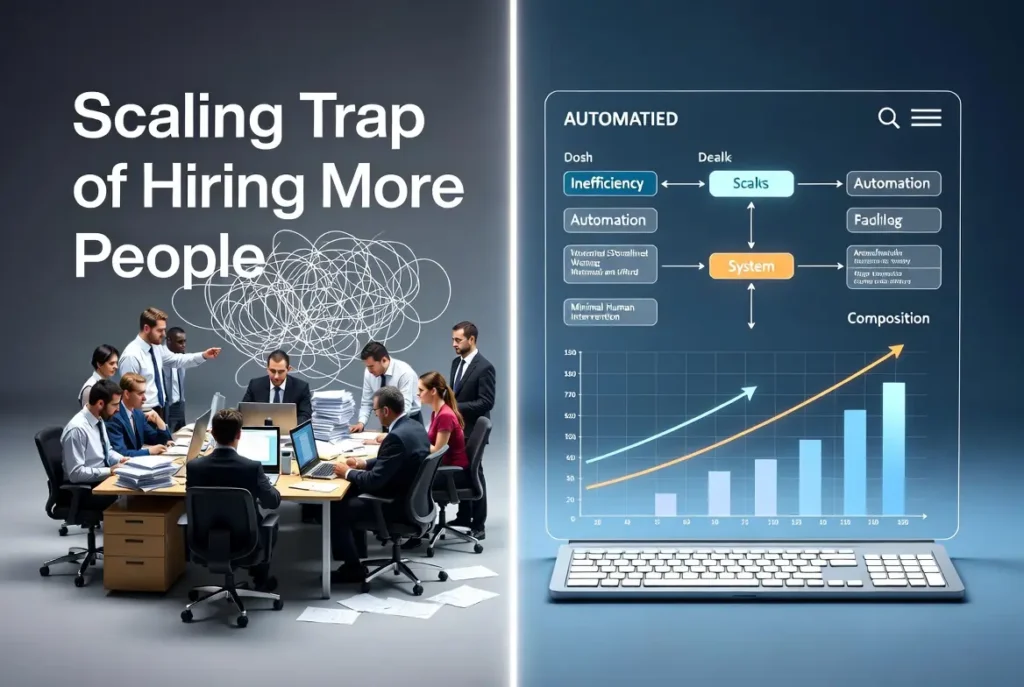
The Lean Operations Movement is rejecting linear hiring. Instead of adding staff, modern founders pursue Operational Leverage: increasing output per person using systems, AI agents, and automation.
If you’re scaling from $1M to $5M — or trying to — this article explains how to do it without building a management-heavy organization.
What Is the “Scaling Trap” in Business?
The Scaling Trap occurs when revenue growth requires proportional hiring, payroll expands faster than profit, management overhead consumes leadership time, and founders shift from creator → manager. Growth becomes linear, complexity exponential, margins decline.
Why Headcount Is a Vanity Metric in 2026
Today, serious operators track: Revenue per employee, Profit per employee, Profit/Person Ratio, Operating Leverage. If adding employees lowers margins, growth is cosmetic. Hiring increases fixed costs. Systems create scalable output.
Operating Leverage: The Core Concept
Operating leverage means increasing revenue without increasing costs at the same rate. Instead of hiring 3 coordinators, you build: automated lead-to-fulfillment systems, SOP automation, AI-augmented workflows, centralized data architecture. Revenue scales. Headcount stays flat.
The Financial Reality: Hire vs Automate (3-Year Model)
💰 Fully Loaded Cost of a Hire
$60,000 salary + 20% taxes & benefits + software + training + management time → ~$80,000–$95,000 per year.
Over 3 years: $240,000–$285,000+
⚙️ System Implementation Cost
Automation build (Make.com) + SOP documentation (Notion) + Airtable backend + AI agent integrations → $10,000–$40,000 one-time + minor maintenance.
The delta is enormous.
This is why reducing payroll expenses via AI is accelerating in 2026.
Hire 3-year cost: $85k × 3 = $255k

Automation build: $25k one-time

Savings: $230k + lower management load Signs You’re in the Hiring Trap
- Profit is lower after hiring
- You spend more time managing than building
- Team productivity drops as you grow
- Decisions slow down
- You feel exhausted managing people
Many founders: “I built a business. Now it feels like it owns me.” That’s management overhead expanding faster than revenue.
Systematizing vs Staffing for SME Growth
Two ways to increase output: add labor, or increase system efficiency. Traditional SMEs choose labor. Lean operators choose system architecture: business process mapping, SOP automation, automated project tracking, AI task routing. This transforms a business into a self‑managing system.
Building a Headless Business (The 2026 Blueprint)
A “headless” business does not rely on constant human supervision. It runs on: documented SOPs, trigger‑based workflows, AI agents, central data infrastructure.
- Make.com for automation
- Airtable as central operations brain
- Notion for SOPs
- AI agents for execution
Instead of delegating to a person, you automate delegation. This is automated delegating with AI agents.
Escaping Management Fatigue
One of the most searched emotional queries in 2026: “Managing people is exhausting.” Every new hire adds meetings, clarifications, performance management, emotional energy. Systems do not require motivation — they require logic. When you reduce management overhead, you regain strategic thinking time, creative control, founder leverage.
AI-Augmented Workforce: Replacing Entry-Level Roles
Instead of hiring data entry assistants, project coordinators, reporting analysts, junior marketers → deploy AI reporting agents, automated CRM enrichment, workflow orchestration bots, AI customer service triage. High‑level fractional talent replaces full‑time generalists.
Example: hire a fractional COO to design systems once — then let automation run them. This is fractional talent vs full‑time hire strategy.
From $1M to $5M Without Hiring
1. Revenue per Employee
Calculate: total revenue ÷ total employees. Ask: “How can we double output per person?” Remove repetitive tasks, automate reporting, standardize delivery, pre‑build decision trees.
2. Lead-to-Fulfillment Systems
Map entire flow: lead → qualification → proposal → payment → delivery → follow‑up. Every manual handoff is a hiring trigger. Automate transitions with Make.com: when payment received → trigger onboarding; when onboarding complete → create delivery tasks; when milestone reached → auto‑invoice. No coordinator needed.
Trigger: Payment received in Stripe

→ Make.com: create Airtable record

→ send Slack notification

→ assign tasks via AI agent 3. The 80/20 Rule in HR
20% of activities drive 80% of results. 80% create operational drag. Systematize the 20%. Eliminate or automate the rest. This dramatically increases profit margin scaling strategies.
Overhead vs Systems: The Profit Margin Defense
Overhead grows quietly. Systems compound quietly. Every payroll addition increases fixed burn rate, risk exposure, break‑even point. Every automation increases speed, consistency, margin. Lean operators view hiring as a last resort — not a default response to growth.
Agency De-Scaling: The Counterintuitive Move
2026 search trend: How to downsize team and increase profit. Agencies discovered: revenue up 40%, headcount up 60%, profit flat. After systemization: headcount down 30%, revenue stable, profit up 25%. Removing layers increases velocity. This is operational leverage in action.
Hire vs Automate: 3‑Year Impact
Hire 1 FTE
management overhead, training, risk
Automate
scalable, 24/7, consistent output
Tools for Lean System Architecture
- SOP & Documentation: Notion, Trainual
- Automation & Orchestration: Make.com, AI agents (AutoGPT, CrewAI)
- Central Database: Airtable
- Strategic Oversight: Fractional COO
The goal is not more software — it’s integrated system design.
Frameworks That Support This Shift
- Clockwork (design business to run without you)
- The E-Myth (systematize before scaling)
- Built to Sell (remove founder dependency)
- Skin in the Game (optimize risk asymmetry)
FAQ (Rich Snippet Optimized)
What is the “Scaling Trap” in business?
When revenue growth requires proportional hiring, reducing profit margins and increasing management complexity.
Can a business scale without hiring more people?
Yes. Through operational leverage — using AI, automation, and standardized systems to increase output per person.
How do I calculate if I should hire or automate?
Compare the fully‑loaded 3‑year cost of an employee vs. the one‑time build and maintenance cost of a system.
Is it better to hire a Virtual Assistant or build an automated workflow?
If the task is repetitive and rule‑based, automate it. Hire only when judgment and creativity are required.
What are the signs of a hiring trap?
Lower margins after hiring, slower decisions, increased meetings, and founder burnout.
The Strategic Shift: From Headcount to Leverage
The old growth model: more revenue → more hires → more complexity. The 2026 model: more revenue → better systems → stable headcount → higher margins. The founders who win this decade will not be those with the largest teams. They will be those with the highest revenue per employee, profit per person, operating leverage.
Scaling is not about adding people. It’s about designing systems powerful enough that you don’t have to.
⚙️ operating leverage · systems not staff · scale profit