

AI Doesn’t Browse the Web — It Interprets It

In 2026, AI engines do not browse websites the way humans or traditional search bots do. They don’t read pages line by line. They don’t care about your page views. And they don’t reward content just because it’s long or well-written.
Source: Google explains that AI Overviews are designed to provide a quick overview with links to learn more (i.e., answers first, pages second): Generative AI in Search: Let Google do the searching for you.
They cross-check:
-
Homepage
-
About page
-
Blog articles
-
Product pages
-
Metadata
-
Structured data
Source: Structured data exists to make page meaning machine-readable and consistent across sites (via shared vocabularies like Schema.org): W3C Schema.org Community Group.
How Perplexity Reads Websites
Perplexity is citation-driven.
Source: Perplexity describes its product as “AI-powered search with sources and citations”: Perplexity: what we are and what’s next.
Most website owners still imagine AI engines as “advanced search engines.”
They picture ChatGPT, Perplexity, or Google AI:
-
Crawling pages
-
Scanning keywords
-
Ranking results
-
Showing links
That mental model is outdated.
In 2026, AI engines do not browse websites the way humans or traditional search bots do. They don’t read pages line by line. They don’t care about your page views. And they don’t reward content just because it’s long or well-written.
Instead, AI engines interpret websites as knowledge systems.
They extract meaning, verify consistency, connect entities, and decide whether your site is useful enough to be reused in answers.
Understanding how AI engines read websites is now the difference between:
-
Being visible everywhere
-
Or silently disappearing from AI-generated answers
This article explains how modern AI engines read websites, what they look for, what they ignore, and why most WordPress sites are misunderstood—or completely skipped—by AI in 2026.
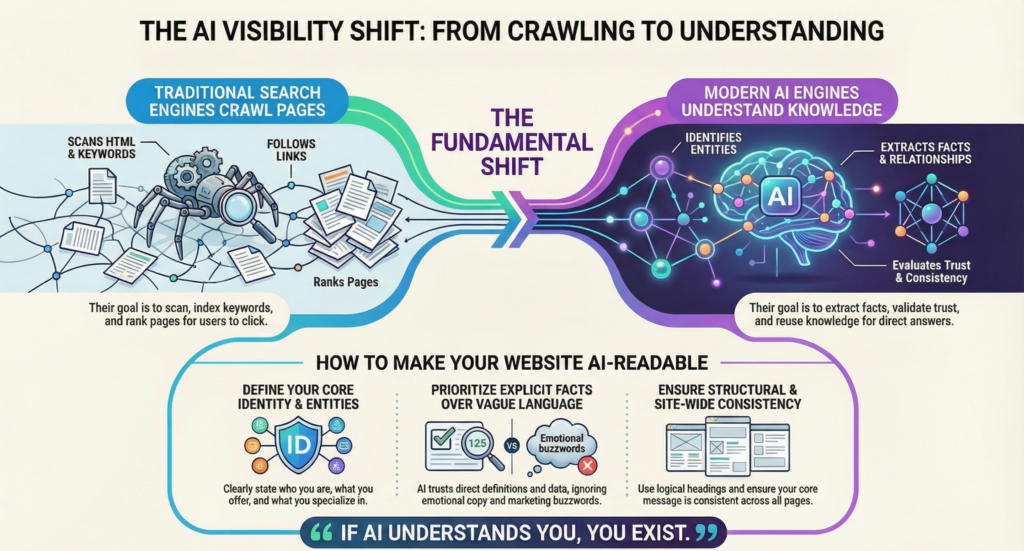
The Fundamental Difference: Crawling vs Understanding
Traditional search engines were built to crawl.
AI engines are built to understand.
How Search Engines Read Websites (Old Model)
-
Scan HTML
-
Index keywords
-
Follow links
-
Rank pages
How AI Engines Read Websites (New Model)
-
Identify entities
-
Extract facts
-
Validate relationships
-
Evaluate trust
-
Reuse knowledge
AI engines are not trying to show users pages.
They are trying to deliver answers.
If your website cannot be converted into reliable knowledge, it is ignored.
Step 1: AI Identifies “What This Website Is”
The first thing AI engines do is classification.
Before reading your content, AI asks:
-
Is this a business?
-
A blog?
-
A product site?
-
A media source?
-
An authority in a niche?
Most websites fail here because they never clearly state their identity.
What AI Looks For
-
Clear descriptions of purpose
-
Consistent messaging across pages
-
Explicit statements of what the site represents
What AI Ignores
-
Vague branding slogans
-
Generic “About Us” pages
-
Marketing language without definitions
If AI cannot confidently classify your site, it immediately reduces trust.
Step 2: AI Detects Core Entities
Once the site is classified, AI engines search for entities.
Entities are the backbone of AI understanding.
Examples:
-
A company name
-
A product
-
A service
-
A person
-
A location
-
A concept
AI engines like ChatGPT and Google AI build entity maps.
If your website does not clearly define:
-
Who you are
-
What you offer
-
What you specialize in
AI cannot anchor your content in its knowledge graph.
This is why many WordPress sites “exist” to humans but do not exist to AI.
Step 3: AI Extracts Explicit Facts (Not Implied Meaning)
Humans infer meaning.
AI engines do not.
AI only trusts explicit information.
Example
Human-friendly text:
“We help businesses grow using innovative AI solutions.”
AI-readable text:
“AIVO is a WordPress plugin that helps websites improve AI visibility by generating structured, AI-readable fact sheets and entity data.”
AI engines extract:
-
Definitions
-
Attributes
-
Capabilities
-
Limitations
-
Relationships
If these are missing, the content is emotionally persuasive—but technically useless.
Step 4: AI Evaluates Structural Clarity
AI engines rely heavily on structure.
This includes:
-
Heading hierarchy
-
Section consistency
-
Topic separation
-
Predictable formatting
Most WordPress themes break AI readability by:
-
Using headings for design, not meaning
-
Mixing multiple topics in one page
-
Hiding important content in sliders or tabs
-
Overusing blocks without semantic logic
AI does not “scroll.”
It parses.
Poor structure equals poor understanding.
Step 5: AI Checks Consistency Across the Entire Site
AI engines never trust a single page.
They cross-check:
-
Homepage
-
About page
-
Blog articles
-
Product pages
-
Metadata
-
Structured data
If your site says:
-
One thing on the homepage
-
Another thing in blog posts
-
A third version in schema
AI flags inconsistency.
Inconsistency = lower trust = reduced visibility.
This is one of the biggest reasons WordPress sites fail with AI engines:
Content is written over time, by different people, without a unified knowledge layer.
Step 6: AI Determines Authority and Reliability
AI engines don’t measure authority like humans do.
They look for:
-
Depth of explanation
-
Specificity
-
Repetition of core truths
-
Absence of contradictions
-
Alignment with known knowledge
Authority is not about:
-
Domain age
-
Brand size
-
Traffic volume
Authority is about clarity and confidence of knowledge.
A small website with precise definitions often outperforms a large brand with vague messaging.
How Different AI Engines Read Websites
While the core logic is similar, each AI engine has a slightly different emphasis.
How ChatGPT Reads Websites
ChatGPT:
-
Prioritizes clarity of explanation
-
Values structured summaries
-
Relies heavily on entity definitions
-
Avoids ambiguous or promotional content
ChatGPT prefers content that:
-
Explains concepts clearly
-
Uses consistent terminology
-
States facts confidently
-
Avoids hype
If your content sounds like marketing, ChatGPT is less likely to reuse it.
How Perplexity Reads Websites
Perplexity is citation-driven.
It looks for:
-
Verifiable statements
-
Clear sourcing
-
Fact-based explanations
-
Logical structure
Perplexity favors:
-
Educational tone
-
Explicit claims
-
Clear context
If your content is well-structured and factual, Perplexity is more likely to cite it—even if your site is small.
How Google AI Reads Websites
Google AI combines:
-
Traditional indexing
-
Entity recognition
-
Knowledge graph alignment
-
Trust signals
Google AI evaluates:
-
Consistency with known entities
-
Schema alignment
-
Semantic depth
-
Content intent
Google AI often rewrites answers in its own words—but only if it trusts the source.
What AI Engines Ignore (Even If Humans Love It)
AI engines largely ignore:
-
Emotional storytelling without facts
-
Clever copywriting without definitions
-
Buzzwords without explanation
-
Over-optimized SEO fluff
-
Pages written only to rank
This is why many “SEO-perfect” pages never appear in AI answers.
Why WordPress Sites Struggle with AI Interpretation
WordPress was not designed for AI engines.
Its weaknesses include:
-
Content-first, knowledge-last architecture
-
Page-based thinking instead of entity-based thinking
-
SEO plugins focused on metadata, not meaning
-
Themes optimized for appearance, not semantics
As a result, AI engines see many WordPress sites as:
-
Fragmented
-
Inconsistent
-
Ambiguous
-
Low-confidence sources
The Shift: From Pages to Knowledge Layers
AI engines don’t want pages.
They want knowledge layers.
A knowledge layer includes:
-
Who you are
-
What you do
-
What you know
-
How everything connects
This layer must exist above design, SEO, and content volume.
This is why AI-focused optimization approaches—such as AI Visibility Optimization (AIVO)—are emerging to fill the gap WordPress leaves open.
How to Make Your Website Easier for AI Engines to Read
Without changing your entire site, you can:
-
Define your core entities clearly
-
Add structured summaries to key pages
-
Ensure consistency across content
-
Separate topics cleanly
-
Replace vague language with explicit facts
-
Optimize for AI understanding, not clicks
The goal is simple:
Make your website easy for AI to understand, not just for humans to enjoy.
The Future: Websites as AI Knowledge Sources
In 2026 and beyond, AI engines decide:
-
Which sources get reused
-
Which voices are amplified
-
Which websites matter
Websites that adapt become:
-
Trusted references
-
AI-cited authorities
-
Long-term visibility assets
Websites that don’t adapt slowly fade—often without traffic drops at first, making the loss hard to detect.
The New Rule of Visibility
The old rule was:
“If you rank, you win.”
The new rule is:
“If AI understands you, you exist.”
AI engines don’t reward effort.
They reward clarity.
They don’t care how beautiful your site is.
They care how understandable it is.
If your website can be turned into knowledge, AI will use it.
If it can’t—it will be skipped.
And in an AI-first web, being skipped is the same as being invisible.
Frequently Asked Questions (FAQs)
1. How do AI engines read websites differently from search engines?
AI engines do not crawl websites just to rank pages. They interpret websites as knowledge systems by identifying entities, extracting facts, validating consistency, and deciding whether the information can be reused in AI-generated answers.
2. Do AI engines like ChatGPT and Google AI read entire web pages?
No. AI engines do not read pages line by line like humans. They parse structure, headings, entities, and explicit facts to extract meaning rather than consuming the full page as text.
3. What is the first thing AI engines look for on a website?
AI engines first try to understand what the website represents. They classify whether the site is a business, blog, product, service provider, or authority source before evaluating its content.
4. What are entities and why do AI engines rely on them?
Entities are clearly defined concepts such as companies, products, services, people, or locations. AI engines rely on entities to build knowledge graphs and understand how information connects across the web.
5. Why do AI engines prefer explicit facts over storytelling?
AI engines cannot infer meaning the way humans do. They rely on explicit definitions, attributes, and relationships rather than implied or emotional storytelling, which is difficult to extract reliably.
6. Can a visually well-designed website still confuse AI engines?
Yes. AI engines prioritize structure and semantics over visual design. Websites that rely heavily on design elements without clear content hierarchy often perform poorly in AI interpretation.
7. How does content structure affect AI understanding?
Clear heading hierarchy, topic separation, and predictable formatting help AI engines extract meaning. Poor structure makes it harder for AI to identify what each section represents.
8. Why is content consistency important for AI engines?
AI engines cross-check information across multiple pages. If a website presents conflicting or inconsistent information, AI systems reduce trust and limit visibility.
9. How does ChatGPT evaluate website content?
ChatGPT prioritizes clarity, structured explanations, consistent terminology, and factual accuracy. It avoids promotional language and prefers content that explains concepts directly.
10. How does Perplexity evaluate website content?
Perplexity focuses on verifiable facts, clear explanations, and structured information. It favors content that can be cited and referenced confidently, regardless of brand size.
11. How does Google AI evaluate websites differently?
Google AI combines traditional search signals with entity recognition, knowledge graph alignment, and semantic depth. It evaluates whether content aligns with known facts and trusted entities.
12. Why do many SEO-optimized pages fail in AI answers?
Many SEO pages are written to rank rather than to explain. AI engines often ignore keyword-heavy or promotional content that lacks clear definitions and factual structure.
13. Can small websites appear in AI-generated answers?
Yes. AI engines prioritize clarity and trust over domain authority. Small websites with well-structured, explicit knowledge often outperform larger brands in AI visibility.
14. Why do WordPress websites struggle with AI interpretation?
WordPress is content-focused, not knowledge-focused. Many WordPress sites lack entity definition, structured summaries, and site-wide consistency, making them harder for AI engines to understand.
15. What is a knowledge layer in the context of AI engines?
A knowledge layer is the structured understanding of who a website represents, what it offers, and how its content connects. AI engines rely on this layer rather than individual pages.
16. Do AI engines care about page views or traffic?
No. AI engines care about whether content can be trusted, understood, and reused. Traffic metrics do not influence AI visibility directly.
17. What kind of content do AI engines usually ignore?
AI engines often ignore vague marketing language, emotional copy without facts, buzzwords, over-optimized SEO content, and pages that lack clear purpose or structure.
18. How can website owners improve AI readability without redesigning?
They can define entities clearly, add structured summaries, ensure content consistency, separate topics logically, and replace vague statements with explicit facts.
19. Is AI-readable content only important for AI tools like ChatGPT?
No. AI-readable content improves visibility across all AI-driven systems, including search AI, voice assistants, recommendation engines, and future discovery platforms.
20. What is the most important factor for AI visibility in 2026?
The most important factor is whether AI engines can confidently understand and reuse a website’s knowledge. If AI understands you, you exist. If it doesn’t, you’re invisible.