

Introduction: The Silent Shift Most Websites Didn’t Notice
In 2026, something fundamental has changed on the internet—but many WordPress site owners still don’t realize it.
Search engines no longer just crawl your website. AI assistants no longer just summarize your content. Large language models no longer just reference your pages.
They read, interpret, extract, verify, and rank meaning.
This is where AI readable content comes in—and why most WordPress websites are quietly becoming invisible to AI-driven traffic.
Traditional SEO is no longer enough. Keyword density, backlinks, even classic schema markup are now baseline expectations, not advantages. What matters today is whether your content can be understood, trusted, and reused by AI systems.
And here’s the hard truth: Most WordPress sites in 2026 are still written for humans only—not for AI readers.
In 2025, research and industry reporting showed AI summary experiences materially reducing click-through behavior when they appear, accelerating “zero-click” outcomes.
(Source: Pew Research Center (Jul 2025))
In parallel, publishers and marketers reported meaningful organic traffic impacts linked to AI Overviews (often cited in the range of 15%–64% depending on query type and industry).
(Source: Forbes (Apr 2025))
This article explains what AI readable content really means, how it differs from traditional SEO content, why WordPress sites are failing at it, and what you must change now to stay visible in an AI-first web.
What Is AI Readable Content? (Beyond SEO and Keywords)
AI readable content is content structured for machine understanding, not just human readability or search engine crawling.
It allows AI systems—such as search engines, AI assistants, recommendation engines, and knowledge graphs—to:
- Understand who you are
- Identify what your content is about
- Extract facts, relationships, and entities
- Verify trust, authority, and consistency
- Reuse your content in answers, summaries, and recommendations
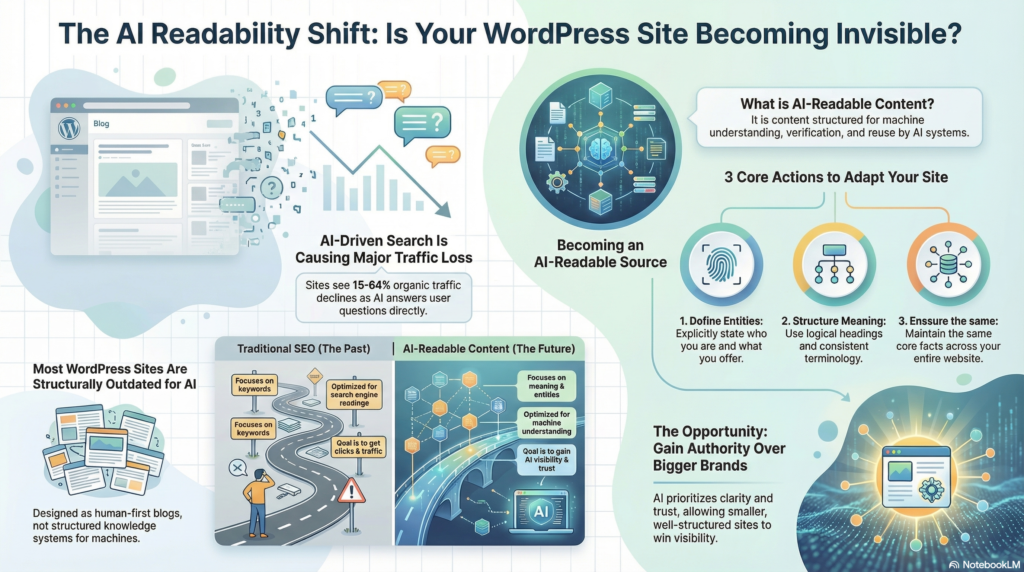
AI Readable vs SEO-Optimized Content
| Traditional SEO | AI-Readable Content |
|---|---|
| Focuses on keywords | Focuses on meaning |
| Optimized for rankings | Optimized for understanding |
| Written for search engines | Written for AI systems |
| Page-level optimization | Site-wide knowledge consistency |
| Traffic-based | Visibility-based |
SEO asks: “Will this page rank?” AI-readability asks: “Can this content be understood, trusted, and reused by AI?”
Why 2026 Is the Breaking Point
Before 2024, AI systems were mainly linked to content. By 2025, they summarized the content. In 2026, they now answer instead of linking—often with fewer clicks when AI summaries appear.
(Source: Pew Research Center (Jul 2025))
This shift means:
- Users ask AI tools questions instead of Googling (e.g., Perplexity’s CEO stated ~780 million queries in May 2025).
(Source: Search Engine Land (Jun 2025)) - AI gives direct answers without sending traffic
- Only AI-readable sources get cited, referenced, or mentioned
Multiple industry surveys and reports in 2025 also found broad traffic pressure associated with AI Overviews/AI summaries, with a meaningful share of marketers reporting declines.
(Source: Fractl (2025))
The Core Elements of AI Readable Content
AI-readable content is not magic. It is built on five foundational pillars.
-
Clear Entity Definition AI doesn’t “guess.” It identifies entities. An entity can be:
- A person
- A company
- A product
- A service
- A location
- A concept
Most WordPress sites fail because they never explicitly define:
- Who the site represents
- What the site offers
- What entities are authoritative
Example (Bad): “We provide innovative digital solutions.” Example (AI-Readable): “Dokkanak is an eCommerce platform based in the UAE that sells outdoor equipment including camping gear, solar generators, and electric bikes.”
AI needs explicit clarity, not marketing fluff.
-
Structured Meaning (Not Just Pretty Text) AI does not read like humans. It relies on:
- Headings hierarchy
- Consistent terminology
- Logical content flow
- Repeated semantic patterns
Many WordPress themes prioritize design over structure. Common problems:
- Skipped heading levels (H1 → H4)
- Long unbroken paragraphs
- Inconsistent terminology
- Multiple topics mixed into one page
AI-readable content is modular, predictable, and logically segmented.
-
Machine-Extractable Facts AI systems extract facts, not opinions. If your content does not clearly state:
- Definitions
- Attributes
- Relationships
- Capabilities
- Limitations
Then AI cannot reuse it.
Example (Human-Friendly but AI-Weak): “Our plugin helps websites improve AI visibility.” Example (AI-Readable): “AIVO is a WordPress plugin that generates AI-readable fact sheets, structured entity data, and machine-readable summaries to improve AI visibility.”
-
Consistency Across the Entire Website AI does not evaluate pages in isolation. It checks:
- Homepage
- About page
- Blog posts
- Product pages
- Metadata
- Structured data
If your site says one thing on the homepage and something different elsewhere, AI flags inconsistency → trust decreases → visibility drops.
Most WordPress sites fail here because content is written by different authors, updated randomly, or affected by conflicting plugin metadata.
-
Explicit Purpose and Context Humans infer context. AI does not. AI needs to know:
- Why this content exists
- Who it is for
- What problem it solves
- How it relates to other content
Pages without clear intent are invisible to AI.
Why WordPress Sites Are Missing AI-Readable Content
WordPress powers roughly ~43% of the web (as measured by W3Techs).
(Source: W3Techs (updated continuously))
Here’s why.
-
WordPress Was Built for Blogs, Not Knowledge Systems WordPress originated as a blogging platform. Its core assumptions:
- Posts are chronological
- Pages are static
- Content is human-written
- SEO plugins handle visibility
AI requires entity relationships, knowledge consistency, machine-readable summaries, and structured facts—none of which WordPress provides by default.
-
SEO Plugins Stop at Search Engines Popular plugins like Yoast, Rank Math, and All in One SEO focus on meta titles, descriptions, sitemaps, and basic schema. They do not deeply define entities, create AI-readable summaries, ensure cross-page consistency, or generate machine-first explanations.
-
Themes Prioritize Design Over Semantics Most WordPress themes are visually impressive but semantically weak, with div-heavy layouts, missing semantic HTML, and content blocks that break logical flow. AI struggles to extract meaning from such structures.
-
Content Is Written for Humans Only Most WordPress content is emotional, story-driven, marketing-heavy, and assumption-based. AI needs explicit facts, clear definitions, repetition of core concepts, and predictable structure.
-
No AI Visibility Analytics WordPress owners track traffic, bounce rates, and conversions—but not AI mentions, citations, or knowledge graph inclusion.
Meanwhile, third-party measurement shows generative AI platforms are now driving large-scale referrals and measurable conversion behavior (e.g., Similarweb reported >1.1B AI referral visits in June 2025 and ~7% conversion to transactional sites in that period).
(Source: Similarweb (Dec 2025))
The Rise of AI Visibility (Replacing Traditional SEO Metrics)
In 2026, visibility means being referenced by AI assistants, cited in AI answers, used in summaries, and included in knowledge graphs.
At the same time, industry data indicates click-through rates fall significantly on queries where AI summaries/overviews appear—changing what “SEO success” looks like.
(Source: Seer Interactive (Sep 2025))
If your content cannot be parsed, trusted, extracted, or reused, it does not exist to AI.
How AI-Readable Content Changes Content Strategy
Old Content Strategy
- Write blog posts
- Target keywords
- Rank on Google
- Get clicks
New Content Strategy (2026)
- Define entities
- Structure knowledge
- Feed AI systems
- Gain visibility everywhere
Traffic becomes secondary. Authority becomes primary.
How WordPress Sites Can Fix This (Without Rebuilding Everything)
The good news: you don’t need to abandon WordPress.
Key actions include:
- Add AI-Readable Fact Layers (define business, products, services, expertise explicitly)
- Create Structured Summaries (human- and machine-readable, consistent across pages)
- Align Content With Entities (one entity per page, clear relationships and attributes)
- Use AI Visibility Tools (focusing on readability, consistency, understanding, and analytics—beyond traditional SEO)
This is where concepts like AI Visibility Optimization (AIVO) emerge—bridging the gap between human content and AI consumption.
The Future: Websites as Knowledge Sources, Not Pages
In 2026 and beyond, websites are no longer just collections of pages. They are knowledge sources, trust nodes, and AI reference points.
AI-readable content transforms your WordPress site into a structured knowledge base, trusted AI source, and long-term visibility asset.
Those who adapt will dominate AI answers. Those who don’t will slowly disappear—without knowing why.
The Hidden Opportunity
AI-readable content is not a trend. It is the new infrastructure of the web.
Most WordPress sites are missing it—not because they are bad, but because they were never built for this reality.
In practice, the opportunity goes to early movers who build machine-usable structure and stable facts that AI can cite with confidence.
- Early adopters gain authority
- Structured sites outperform bigger brands
- Small WordPress sites can win AI visibility
The question is no longer: “Is my site SEO optimized?” The real question in 2026 is: “Can AI understand, trust, and reuse my content?”
If the answer is no—your visibility is already fading.
Frequently Asked Questions (FAQs)
1. What does AI-readable content mean?
AI-readable content is content that is structured so artificial intelligence systems can clearly understand, extract, verify, and reuse its meaning. Unlike traditional SEO content, it focuses on explicit definitions, entities, structured facts, and consistency rather than keywords alone.
2. How is AI-readable content different from SEO-optimized content?
SEO-optimized content is designed to rank in search engines, while AI-readable content is designed to be understood by AI systems. SEO focuses on keywords and backlinks; AI readability focuses on meaning, structure, entities, and machine extractability.
3. Why is AI-readable content important in 2026?
In 2026, AI assistants often answer user questions directly instead of sending traffic to websites. Only AI-readable content gets cited, referenced, or included in AI-generated answers, making it critical for visibility beyond traditional search results.
4. Can a website rank on Google but still be invisible to AI?
Yes. A website can rank well in search results but still be ignored by AI systems if its content lacks clear structure, defined entities, and machine-readable facts. AI visibility and SEO rankings are no longer the same thing.
5. Why are most WordPress sites missing AI-readable content?
Most WordPress sites were built for blogging and human readers, not for AI interpretation. Common issues include weak content structure, inconsistent messaging, lack of entity definition, design-heavy themes, and reliance on SEO plugins that do not optimize for AI understanding.
6. Do SEO plugins like Yoast or Rank Math make content AI-readable?
No. SEO plugins optimize metadata and basic schema for search engines, but they do not create deep entity definitions, structured knowledge, or AI-readable summaries required for AI systems in 2026.
7. What are entities in AI-readable content?
Entities are clearly defined concepts such as a business, product, service, person, or location. AI systems rely on entities to understand what a website represents and how its content relates to the broader knowledge graph.
8. How does AI extract information from content?
AI systems extract structured facts such as definitions, attributes, relationships, and capabilities. Content that relies on vague marketing language or implied meaning is difficult for AI to reuse.
9. Does AI-readable content replace human-friendly writing?
No. AI-readable content should still be natural and humanized, but it must also include explicit structure and clarity for machines. The goal is content that works for humans and AI at the same time.
10. What is AI Visibility?
AI Visibility refers to how often and how accurately a website is mentioned, cited, or used by AI assistants, AI search engines, and AI-generated answers. It replaces traditional traffic-focused metrics with visibility-focused metrics.
11. Why is consistency across a website important for AI?
AI systems evaluate an entire website, not individual pages. If information about a business, product, or service is inconsistent across pages, AI reduces trust and visibility.
12. Can small WordPress sites compete with large brands using AI-readable content?
Yes. AI systems prioritize clarity, trust, and structured knowledge over brand size. Smaller sites with well-structured, AI-readable content can outperform larger brands in AI-generated answers.
13. Does AI-readable content require rebuilding a WordPress site?
No. WordPress sites can be upgraded by adding structured fact layers, consistent summaries, clear entity definitions, and AI-focused optimization tools without changing the entire site.
14. What happens if a site ignores AI-readable content?
Sites that ignore AI readability gradually lose visibility in AI answers, summaries, and recommendations—even if their traditional SEO performance looks stable.
15. How does AI-readable content affect future content strategy?
Content strategy shifts from writing individual blog posts to building structured knowledge systems. The focus moves from traffic generation to long-term authority and AI trust.
16. Is AI-readable content only for tech websites?
No. Any website—eCommerce, service-based, educational, or local business—benefits from AI-readable content because AI systems operate across all industries.
17. What role does AI Visibility Optimization (AIVO) play?
AI Visibility Optimization focuses on making content understandable, consistent, and reusable by AI systems. It bridges the gap between human content and machine consumption.
18. Are AI answers replacing website traffic completely?
Not completely, but AI answers reduce direct clicks. Visibility, authority, and citations become more valuable than raw traffic numbers in 2026.
19. How can I tell if my content is AI-readable?
If your content clearly defines who you are, what you offer, and how everything connects—using structured sections, consistent language, and explicit facts—then it is closer to being AI-readable.
20. What is the biggest mistake WordPress site owners make in 2026?
The biggest mistake is assuming that ranking well in search engines automatically means AI systems understand their content. In reality, AI readability requires a different approach.
References
- Pew Research Center (Jul 22, 2025) — Google users are less likely to click when an AI summary appears
- Forbes (Apr 14, 2025) — Reported organic traffic declines associated with AI Overviews (15%–64%)
- Search Engine Land (Jun 6, 2025) — Perplexity reached ~780M queries in May 2025 (CEO quote)
- Fractl (2025) — Survey on marketer-reported traffic losses post AI Overviews rollout
- W3Techs — WordPress usage statistics (WordPress ~43% of all websites)
- Similarweb (Dec 2, 2025) — Generative AI referral scale and conversion signals (~1.1B referrals in Jun 2025; ~7% conversion to transactional sites)
- Seer Interactive (Sep 2025) — CTR impact analysis for queries with AI Overviews