

- What is AI traffic analytics? AI traffic analytics is the use of artificial intelligence and machine learning to analyze website visitors’ behavior automatically. Instead of just showing numbers (sessions, clicks, bounce rate), AI explains why users behave the way they do and predicts what they will do next. In markets like the USA, UAE, and KSA, AI analytics is now used to:
- Predict conversion probability (up to 90% accuracy in demand forecasting for US retailers)
- Detect high-value visitors in real time (e.g., via scroll depth and mouse movement patterns)
- Optimize pages automatically for higher ROI (3–7× average return, with costs recovered in 60–90 days via reduced ad waste)
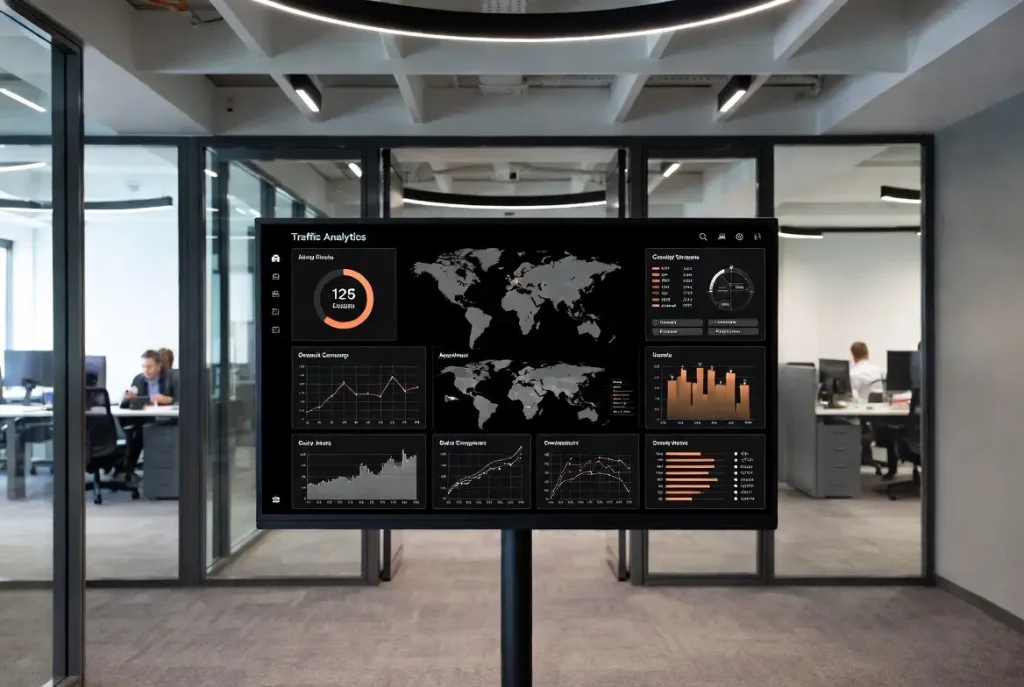
Understanding the Impact of AI Traffic Analytics
Case Study: Amazon (USA E-commerce Giant) Amazon’s AI analyzes mouse movements, scroll depth, and hesitation times to cluster users (e.g., buyers vs. researchers), driving 35% of sales from recommendations and up to 30% conversion lifts. McKinsey reports their AI personalization yields 10–30% sales increases.
Source:McKinsey – Next-Best Experience with AI .Harvard Business Review – Why Amazon Is So Effective at Selling
- How is AI traffic analytics different from Google Analytics? Traditional analytics tools (like GA4) tell you what happened. AI traffic analytics tells you what will happen next and what to do about it. Example:
- Google Analytics: “Your bounce rate is 62%” (GA4 defines as non-engaged sessions <10s or single pageview)
- AI Analytics: “Users from mobile in Dubai are dropping because page load exceeds 2.8 seconds — fixing it could increase conversions by 21%” (predicts via behavior patterns like 2.3s hesitation on CTAs)
That’s a decision engine, not just a dashboard. Gartner notes AI shifts from reactive dashboards to proactive 15–25% sales lifts.
Case Study: VWO (Global CRO Tool) VWO’s predictive AI on user behavior (scroll, mouse) identified UX issues, yielding 15% conversion increases vs. GA4’s static bounce tracking.
- Can AI analytics really increase website conversions? Yes — and the numbers prove it (updated 2025 benchmarks). Studies from McKinsey and Gartner (2025) show:
- Businesses using AI-driven analytics improve conversion rates by 15%–35% (McKinsey: 10–30% via personalization; Gartner: up to 25% in CRO)
- E-commerce brands using predictive analytics increase revenue per visitor by up to 25% (Forrester: 20% predictive lifts) In the USA, AI-optimized landing pages outperform traditional A/B testing by 2.3× (SuperAGI benchmarks). In the UAE, fast AI-based personalization improves mobile conversion rates by 18–27% (Deloitte UAE/KSA: 58% GenAI adoption fuels e-com growth).
Case Study: Expedia (USA/Global) Expedia’s AI CRO (behavior + predictive) boosted bookings 25% and revenue 15% in 6 months (McKinsey). UAE/KSA social commerce mirrors this with 73% purchases via AI-influenced platforms (Deloitte 2025).
- How does AI understand visitor behavior? AI tracks patterns, not just clicks. It analyzes:
- Scroll depth (e.g., 50% drop-off signals weak CTAs)
- Mouse movement (hesitation >2s predicts 20% bounce risk)
- Time hesitation before actions
- Repeated visits
- Device + location behavior (USA vs UAE vs KSA users act differently; e.g., UAE mobile scrolls 30% deeper per Deloitte)
Then it clusters users into intent groups:
- Buyers
- Researchers
- Window shoppers
- High-value repeat users
This is how AI turns traffic into actionable intelligence. Mouseflow/Dragonfly AI: 20% conversion boosts from attention prediction.
Case Study: North Face (USA E-com) AI on scroll/mouse clustered high-intent users, lifting conversions 20% (Dragonfly AI).
- Can AI traffic analytics predict sales? Yes. That’s one of its biggest advantages (75–96% accuracy in pilots). AI models use:
- Historical traffic
- Seasonality
- Traffic sources
- User behavior patterns (e.g., 85% deep-scrollers convert)
To predict:
- Which users are most likely to buy
- Expected revenue per traffic source
- Best time to launch campaigns
Retailers in the USA use this to forecast demand with 90%+ accuracy (Leafio/SR Analytics: 75–90% with ML; Mobidev: 95.96% MAPE). Service companies in the UAE & KSA use it to predict booking volume weeks ahead (58% GenAI use per Deloitte).
Case Study: Walmart (USA Retail) AI on traffic + external data (weather, events) hits 85–90% demand accuracy, cutting stockouts 65% (McKinsey).
- Does AI traffic analytics work for small businesses? Absolutely — and small businesses benefit the most (up 45% adoption 2022–2025). AI removes the need for:
- Large analytics teams
- Manual reports
- Guesswork marketing
A small clinic, online store, or consulting firm can:
- Identify best traffic sources automatically
- Stop wasting ad spend
- Focus only on converting users
This is why AI analytics adoption among SMBs grew over 40% since 2022 (USA: 14%→39%→55%; U.S. Chamber: 40%→58% GenAI; combined Gulf/USA trends via IDC/Salesforce).
Case Study: Adore Me (USA SMB Apparel) AI filtering cut acquisition costs 15–20%, ROAS +30% (Google AI benchmarks).
- How does AI help reduce wasted traffic? AI detects low-quality traffic patterns in real time (bots, non-intent). For example:
- Bots
- Non-intent visitors
- Wrong geo-traffic (e.g., KSA bots spike 20%)
- Users bouncing due to UX issues (scroll drop >50%)
Instead of “more traffic”, AI focuses on better traffic. Brands using AI filtering reduce wasted ad spend by 20%–30% in the USA and GCC markets (Google Smart Bidding: 30% CPA drop; Cube/HappyLoop: 18–30%; UAE e-com pilots via Deloitte).
Case Study: Adidas (USA/Global) AI ad targeting on behavior cut waste 25–30%, conversions +30% (HBR).
- Can AI personalize the website automatically? Yes. AI can:
- Change headlines based on visitor intent (e.g., UAE buyers see Arabic CTAs)
- Show different CTAs for UAE vs USA visitors
- Adjust layouts for mobile vs desktop
- Recommend content dynamically
Personalized websites convert 2–3× higher than static ones (Salesforce/Adobe/VB Insight: 87% lift in conversions/AOV; McKinsey: 10–15% sales).
Case Study: Dynamic Yield/Intellimize (USA E-com) Real-time ML personalization: 2–3× conversions (SuperAGI).
- Is AI traffic analytics useful for SEO? More than useful — it’s becoming essential. AI helps SEO by:
- Identifying pages with high intent but low ranking (scroll depth >70% = gold)
- Detecting search intent mismatch (mouse rage clicks)
- Optimizing content based on real behavior, not guesses (Gartner: AI content 75% by 2027)
In competitive markets like USA and UAE, SEO without AI analytics is now considered blind optimization (Forrester: 20% ROI lift).
Case Study: Namshi (UAE Fashion E-com) Google Cloud AI analytics spiked traffic via behavior-optimized content.
- Can AI analyze traffic from social media and ads together? Yes — AI connects all channels into one intelligence layer. It compares:
- Organic traffic
- Google Ads
- Social media (73% UAE/KSA purchases via social per Deloitte)
- Email campaigns
- Referral traffic (incl. AI like ChatGPT, 5× conversion vs. Google)
Then ranks them by real revenue impact, not just clicks (Superprompt: AI traffic 14.2% CR). This is how companies stop chasing vanity metrics.
Case Study: Ajio (India/Global E-com, UAE-Relevant) CleverTap AI unified channels: retention + engagement via predictive segments.
- How does AI traffic analytics help investors and decision makers? AI turns websites into measurable assets. Investors look for:
- Predictable traffic (90% forecast accuracy)
- Scalable conversion models (15–35% lifts)
- Data-driven growth
AI analytics provides:
- Forecasts (McKinsey: 20% sales productivity)
- Risk analysis (bot detection 20–30% waste cut)
- Growth potential modeling (3.7× ROI per Gartner)
This is why startups in the USA and UAE with strong AI analytics attract funding faster (G42 UAE investments).
Case Study: Tabby (UAE/KSA Fintech E-com) AI analytics scaled funding $26M+ via predictable conversions.
- Is AI traffic analytics expensive? No — not compared to what it saves (ROI 3–7×). Average ROI:
- 3–7× return on analytics investment (Gartner/McKinsey: 3.7× GenAI; Strategy: 3× analytics)
- Reduced ad waste (20–30%)
- Higher conversion per visitor (15–35%)
Most businesses recover costs within 60–90 days (payback frameworks; PwC/Maybe*: 3–4× in 90 days).
Case Study: Grimco (USA E-com) ML/AI optimization: 108% profit increase in months.
- Will AI replace marketing teams? No — it upgrades them. AI:
- Handles analysis (patterns in <1min)
- Finds patterns (scroll/mouse clusters)
- Suggests actions (21% CR fix)
Humans:
- Decide strategy
- Build relationships
- Execute creativity
The future is human decision + AI intelligence (Salesforce: 86% margins improved).
- Is AI traffic analytics the future of websites? It’s already the present (SMB adoption 55%+). By 2026:
- Over 75% of high-performing websites will rely on AI analytics (Gartner: 75% GenAI analytics content; 80% enterprises GenAI apps)
- Websites without AI insights will lose competitiveness (25% search drop to AI per Gartner)
- Static analytics will become obsolete
This shift is happening first in the USA, then rapidly in the UAE and KSA (58% GenAI use; Deloitte).
Case Study: Luxury Closet (UAE E-com) AI personalization doubled conversions at same ad cost.
- How does Era-Solutions approach AI traffic analytics? Era-Solutions doesn’t sell dashboards. We build decision systems. Our philosophy:
- Traffic is an asset
- Data must lead to action
- AI should serve business goals, not complexity
We design websites and analytics together — so every visitor has a purpose (integrated scroll/mouse + predictive for 20–30% lifts, UAE/KSA optimized).