

AI in web development is rapidly transforming how websites are planned, built, tested, and optimized. Over the next three years, artificial intelligence will become more deeply embedded in development workflows, helping teams work faster, reduce repetitive tasks, and deliver smarter digital experiences.
Web development has already evolved from static pages into dynamic platforms driven by automation and data. AI is now accelerating this evolution by supporting developers with intelligent tools that improve efficiency while maintaining quality and consistency.
AI-assisted coding and development speed
One of the most immediate impacts of AI in web development is its role in coding assistance. AI-powered tools help developers write cleaner code, suggest improvements, and automate repetitive logic. This significantly reduces development time while minimizing human error.
Instead of manually writing boilerplate code, developers can now rely on AI-driven suggestions and automated snippets. This allows teams to focus on system architecture, performance optimization, and complex problem-solving rather than routine implementation.
According to industry trends, AI-assisted development tools are increasingly adopted to improve productivity and accelerate software delivery cycles.
(Stack Overflow Developer Survey)
Smarter design and user experience
AI in web development is also reshaping website design and user experience. Intelligent systems analyze user behavior, interaction patterns, and engagement data to recommend layout changes and interface improvements.
This data-driven approach allows websites to adapt dynamically to different audiences, improving usability, accessibility, and conversion rates. Designers still make final decisions, but AI provides valuable insights that speed up the design process.
Research on AI-driven UX highlights how behavioral analysis can improve digital experiences when combined with human oversight.
(CMSWire)
Testing, quality assurance, and performance optimization
Testing and quality assurance traditionally require extensive manual effort. AI-driven testing tools are now capable of detecting bugs, identifying performance bottlenecks, and flagging potential issues early in the development cycle.
By continuously monitoring performance metrics such as page load time and responsiveness, AI helps maintain stable and scalable web applications. This is especially valuable as websites grow more complex and traffic volumes increase.
AI-assisted performance monitoring aligns with modern web performance standards and optimization practices.
(Google Web.dev – Performance)
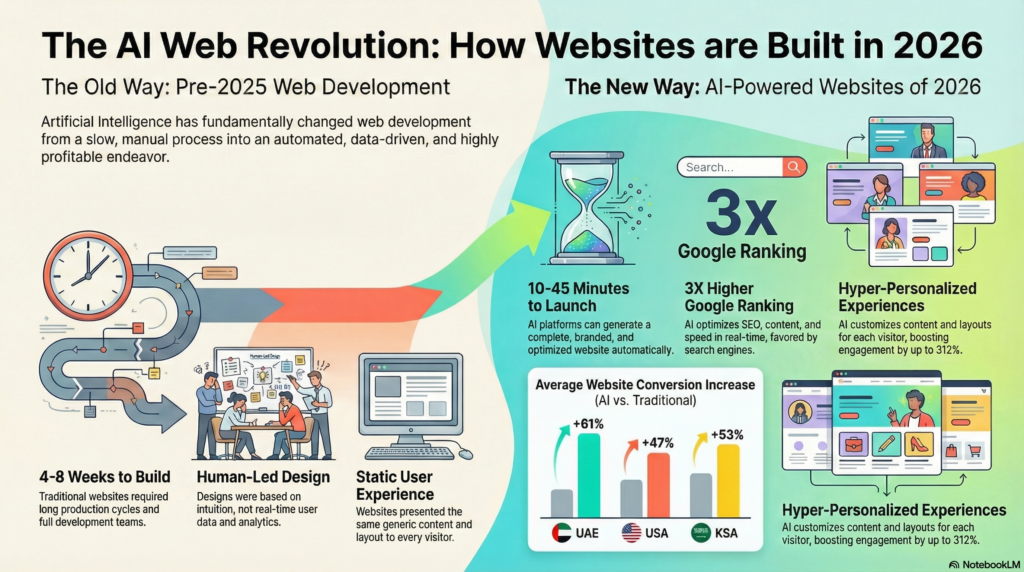
Personalization and behavior-based experiences
Personalization is becoming a core expectation for modern websites. AI enables platforms to tailor content, recommendations, and layouts based on user behavior, preferences, and context.
This capability is particularly valuable for e-commerce, service platforms, and content-heavy websites, where relevance directly impacts engagement and conversion. AI-driven personalization allows businesses to deliver targeted experiences at scale.
Personalized digital experiences are increasingly linked to higher engagement and customer satisfaction.
(Think with Google)
The evolving role of web developers
As AI automates repetitive and time-consuming tasks, the role of web developers continues to evolve. Developers are shifting toward higher-level responsibilities such as system design, security, performance engineering, and integration planning.
Future-ready developers must understand how to work alongside AI tools, validate outputs, and ensure that automation aligns with project goals and quality standards. Human oversight remains critical to maintain reliability and ethical use of AI-generated solutions.
Challenges and responsible AI adoption
Despite its advantages, AI adoption in web development introduces challenges. Issues related to code quality, security vulnerabilities, data privacy, and over-reliance on automation require careful consideration.
Organizations must implement AI responsibly, ensuring transparency, human review, and adherence to best practices. AI should support decision-making—not replace accountability.
Discussions around ethical AI usage emphasize the importance of governance and oversight.
(IBM – AI Ethics)
What the next three years will look like
Over the next three years, AI in web development is expected to become a standard component of web development workflows. Businesses that adopt AI in web development responsibly will benefit from faster delivery cycles, improved user experiences, and more scalable digital platforms.
While automation will continue to increase, creativity, strategic thinking, and human judgment will remain essential. AI will enhance developers’ capabilities rather than replace them, enabling smarter and more efficient web solutions.
For businesses planning long-term digital growth, understanding how AI integrates with web development is no longer optional—it is a strategic necessity.